Query Hunter is worth testing if you already have pages receiving meaningful Google Search impressions and want a faster way to turn Search Console data into a controlled content-refresh queue. It is a poor fit for a new site with little query data, anyone seeking competitor keyword research, or a publisher likely to paste every AI suggestion into an article without editorial review.
The product has changed substantially since our original January 2024 review. Query Hunter is now the browser-based editing companion in the wider Spindrift platform, not the simple standalone subscription described in the old article. An active Spindrift plan is required, and the public plans are billed annually.
| Best for | Refreshing established pages from first-party Search Console data |
|---|---|
| Not for | New sites, competitor research or automatic keyword insertion |
| Entry price | $8.25/month equivalent, billed annually |
| Evidence status | Current facts checked; new hands-on test still required |
What Query Hunter is in 2026
Query Hunter is a Chrome extension included with Spindrift. Spindrift connects to Google Search Console, organizes a site's query and page data, tracks whether important terms appear in the content, and runs daily page audits. Query Hunter brings that information beside the live page or CMS editor so an editor can inspect opportunities while revising the content.
The current workflow is narrower than a full SEO suite:
- Connect a Google Search Console account to Spindrift.
- Add an eligible property as a site within the plan limit.
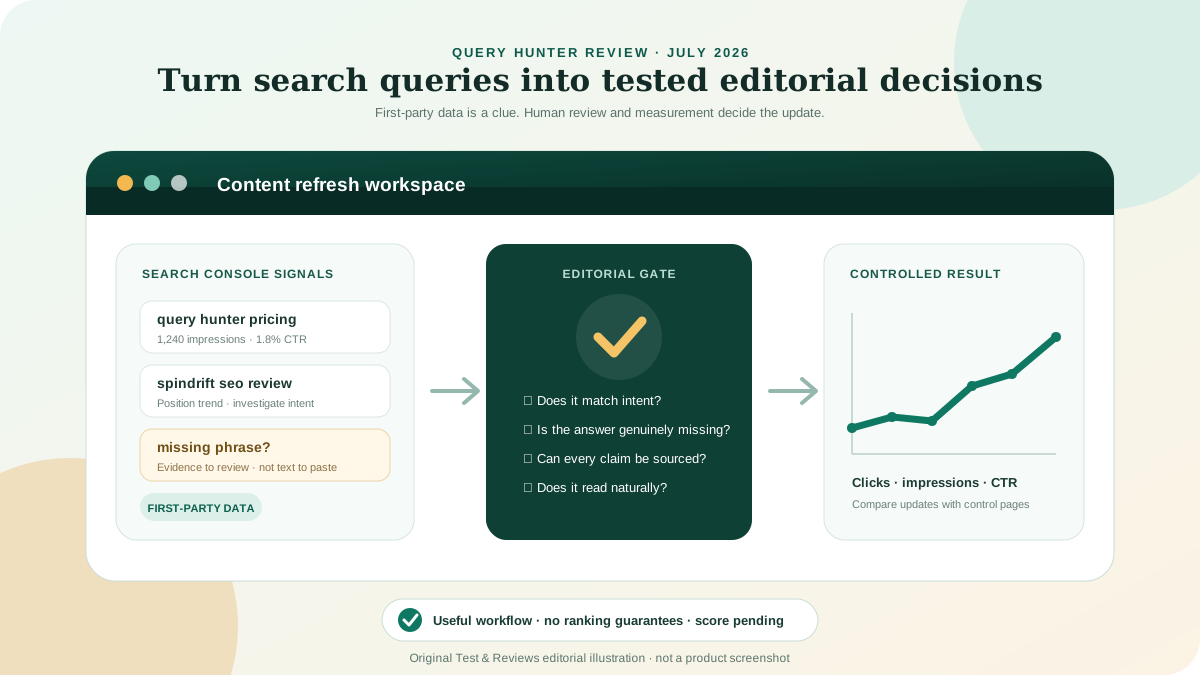
- Find queries with impressions, weak click-through rate, page-two visibility or limited coverage.
- Open the relevant page or editor with the Query Hunter extension.
- Decide whether the query reveals a genuine missing answer, an unclear title, a separate search intent or no useful change at all.
- Edit, document and measure the result instead of assuming the recommendation caused a ranking improvement.
It works with different content-management systems because it is a browser extension. Spindrift specifically advertises an editor integration for WordPress; other systems can still use the extension alongside the published page.
Our verdict in one minute
| Question | Assessment |
|---|---|
| Does it replace Google Search Console? | No. It reorganizes and applies data originating from Search Console. |
| Does it replace Ahrefs, Semrush or Ubersuggest? | No. It does not primarily discover competitor keywords or provide a broad backlink and market-research database. |
| Can it reveal useful refresh ideas? | Yes, especially on established pages with enough query impressions to expose intent gaps. |
| Will adding a missing phrase move page two to page one? | Not necessarily. The query is evidence to investigate, not a ranking guarantee. |
| Should its AI text be published untouched? | No. Every suggestion needs factual, editorial, intent and duplication review. |
| Have we completed a current controlled test? | No. We therefore do not assign a score or repeat the old traffic claims as measured fact. |
Query Hunter and Spindrift pricing
Prices below were checked on July 22, 2026. The public pricing page presents monthly equivalents but states that each plan is billed annually. Tax is not clearly included in the displayed US-dollar figures.
| Plan | Monthly equivalent | Annual total | Included sites | Users |
|---|---|---|---|---|
| Starter | $8.25 | $99 | 1 | Unlimited |
| Pro | $33.25 | $399 | 5 | Unlimited |
| Agency | $83.25 | $999 | 20 | Unlimited |
| Custom | Quote | Quote | Up to unlimited | Unlimited |
Starter, Pro and Agency list daily Search Console updates, page audits, mention-coverage tracking, the Query Hunter extension and AI content optimization. The main published difference is site capacity. Custom also advertises custom historical Search Console imports.
The vendor advertises a free trial but does not state its duration on the public pricing page we checked. The current terms authorize recurring billing until cancellation and prohibit multiple free trials within six months. They also say service limits may be changed, so an agency should confirm AI usage, audit volume, historical-data access and cancellation timing before paying annually.
What Query Hunter does well
It starts with your real audience
Conventional keyword tools estimate a market. Search Console records queries for which Google has actually displayed your pages. That makes Query Hunter particularly useful for content that already earns impressions but may not answer the user's next question clearly enough.
The advantage is prioritization, not magic. An editor can focus on a page that already has relevance and authority instead of publishing another speculative article. The Questions view, page-two filters and query-mention checks can shorten a repetitive manual process.
It places evidence beside the editing workflow
Opening Search Console, exporting data, finding the correct page and checking every phrase manually creates friction. Query Hunter's browser panel can reduce that switching cost. The dedicated WordPress editor integration is the clearest use case, while the extension's CMS-independent approach makes it usable on other platforms.
The current package is more than an extension
The old review assessed Query Hunter mostly as a Chrome extension. The current purchase also includes Spindrift's site-level workspace, daily data refreshes, page audits, coverage tracking and team access. One-site Starter is inexpensive for an established publisher; Pro and Agency should be evaluated by the number of active properties rather than user seats because users are unlimited.
The important limitations
A query is a clue, not an instruction
A page can receive impressions for a phrase without needing the exact phrase inserted into its copy. Low click-through rate may reflect an unappealing title, a mismatched intent, a dominant search feature, brand preference or a result that appears too low to attract clicks. Average position is also an aggregate, not a fixed rank.
Google explains that some anonymized queries are omitted, tables can be truncated, data can be aggregated differently by property and page, and position represents an average topmost result. Query Hunter can make this data easier to use, but it cannot remove those underlying measurement limitations.
It needs an established data set
A new site with few impressions gives the system little first-party evidence. It also cannot show the full competitor demand that the site has never appeared for. Use a broader keyword-research tool for market discovery and Query Hunter for improving pages that already have a search footprint.
AI optimization can become keyword stuffing
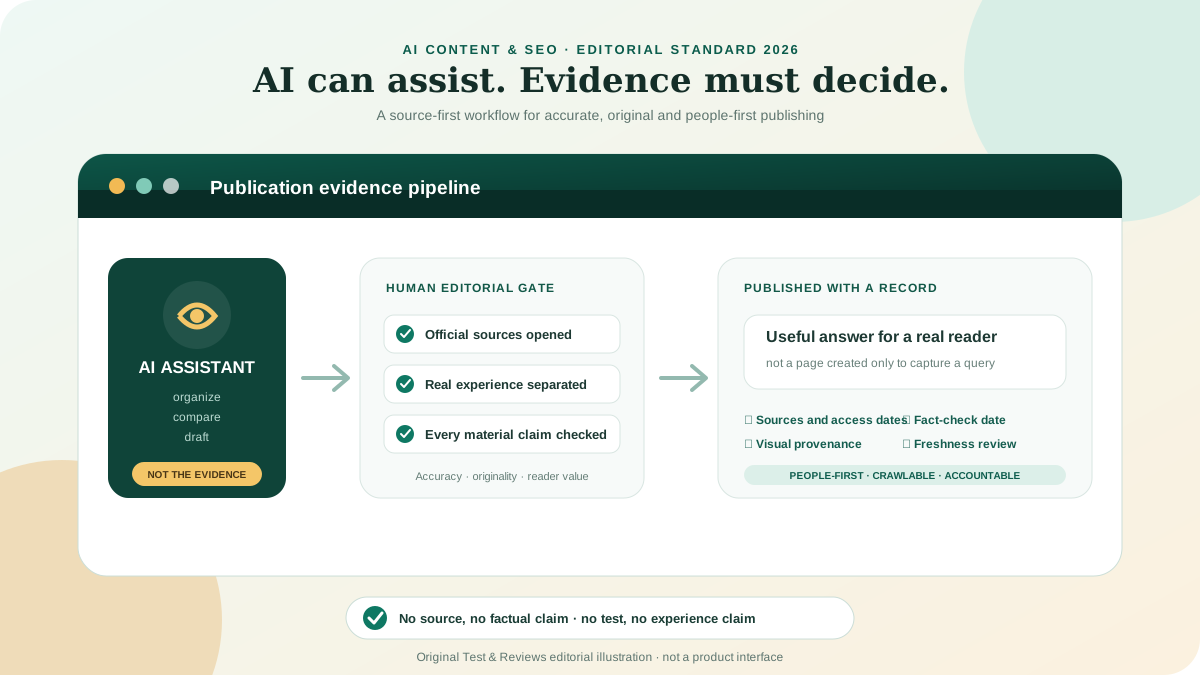
Query Hunter can produce AI-assisted optimization suggestions. That may help draft a missing explanation, but the button does not establish accuracy, originality or usefulness. Google recommends people-first, original content and defines unnatural phrase repetition intended to manipulate rankings as keyword stuffing.
Before accepting a suggestion, ask whether it answers a real reader question, adds information not already present, fits the page's main intent, can be supported by a source and sounds natural. If not, reject it. The safest result is often a clearer paragraph, a better title or a separate article - not another exact-match sentence.
Data access and terms deserve attention
Spindrift requires a Google Search Console connection and processes site-performance and content information. Its privacy policy says it may collect account and usage data, including visual data about interactions at its discretion, and may use third-party service providers. Its terms say account deletion removes Google connections and website records while billing and usage logs can be retained for seven years.
The Chrome Web Store currently displays the developer's declaration that the extension does not collect or use data. That declaration should not be mistaken for the data practices of the connected Spindrift web application. A company handling client properties should review both documents, use a dedicated Google identity where appropriate, grant only necessary access and confirm its processor requirements before connecting accounts.
The terms also permit Spindrift to list a trial or paying customer's brand unless the customer opts out by contacting support. Agencies with confidential clients or strict brand rules should request that opt-out before beginning a trial.
What happened to our original experience?
In January 2024, the site owner wrote that he had used Query Hunter to refresh older posts and had seen more visitors. That is relevant dated experience, but the original article retained no account export, page list, change log, control pages or before-and-after Search Console report. It also repeated vendor testimonials and traffic claims as if they proved the product.
We preserve the honest owner observation, but we cannot convert it into a measured uplift or a current score. The old $75-per-year single-site and $199 multi-site prices, seven-day-trial claim and standalone-product framing have been removed because they no longer describe the public offer.
How we will test Query Hunter properly
- Record the Spindrift plan, annual charge, trial dates, site limits, Google permissions and extension version.
- Export a 90-day native Search Console baseline for at least 20 established pages.
- Create ten matched page pairs using similar traffic, topic age and search visibility; update one page in each pair and leave the other unchanged.
- Classify every recommendation as missing answer, title/snippet issue, intent mismatch, separate-page opportunity or reject.
- Retain the original and edited text, query, reason, source and publication date for every accepted change.
- Review AI suggestions for accuracy, duplication, tone, keyword stuffing and unsupported claims before publication.
- Compare clicks, impressions and click-through rate by page and query after 28 and 56 days; use position only as supporting context.
- Compare results with the matched control pages and account for seasonality, sitewide changes and Google updates.
- Test WordPress and non-WordPress editing, page audits, multiple users, support, cancellation, account deletion and revoked Google access.
A score should follow retained results from that protocol. A ranking increase on one page, a testimonial or a chart without a comparable baseline is not enough.
Who should buy it?
- Choose Starter if one mature site has enough Search Console data and you refresh content every month.
- Choose Pro if a small team actively manages two to five established properties and will use the shared workflow.
- Choose Agency only when close to 20 active sites; idle properties make the annual cost harder to justify.
- Use Search Console directly if you update only a few pages, want no additional data processor or can manage exports and filters manually.
- Use a broader SEO platform when competitor research, backlinks, technical crawling, market-wide keywords or rank tracking is the main job. Our Ubersuggest review covers one lower-cost example.
Final verdict
Query Hunter now looks like a useful specialist layer on top of Search Console, especially at the one-site Starter price. It solves a real workflow problem: finding first-party query opportunities and checking them while editing. The wider Spindrift bundle, unlimited users and daily updates make the 2026 product more capable than the extension described in our original review.
Its biggest risk is also its central idea. Treating every unmentioned query as text to insert can produce bloated, search-first content and misleading conclusions about cause and effect. The tool is most valuable in the hands of an editor who rejects weak recommendations, documents changes and measures outcomes. We recommend a trial with a predefined page set before accepting an annual subscription, and we remain unscored until our current controlled test is complete.
View current Spindrift and Query Hunter pricing - direct official link, not an affiliate link as of this update.
Frequently asked questions
Is Query Hunter still a standalone product?
No. The current Chrome Web Store listing says Query Hunter requires an active Spindrift subscription. The extension is included in Spindrift's paid plans.
How much does Query Hunter cost?
Spindrift Starter is currently displayed as $8.25 per month billed annually, equivalent to $99 per year for one site. Pro is $399 per year for five sites and Agency is $999 per year for 20 sites. Verify the checkout total, tax and current terms before purchasing.
Does Query Hunter work without Google Search Console?
Its central opportunity workflow depends on Search Console data connected through Spindrift. Without a verified property and useful impression history, much of its value disappears.
Will Query Hunter improve rankings?
It can reveal plausible content and click-through opportunities, but neither an identified query nor an edited paragraph guarantees higher rankings. Measure controlled changes in clicks and impressions rather than promising a page-one result.
Does Query Hunter work with WordPress?
Yes. Spindrift advertises a dedicated WordPress editor integration. The Chrome extension can also work beside sites using other content-management systems.
Has Test & Reviews tested the current version?
Not to our current evidence standard. The owner reported using the earlier product in January 2024, but no retained measurement supports a numeric result. The current Spindrift-based version still needs the controlled test described above.
Sources and update record
Product facts and prices were checked against the official Query Hunter product page, Spindrift pricing, workflow guide, privacy policy, terms and the current Chrome Web Store listing. Measurement and editorial cautions were checked against Google's documentation for Search Console query data, data aggregation, people-first content and spam policies. Vendor testimonials were not used as proof of results.