AI-assisted content can rank in Google. Google does not ban a page merely because generative AI helped create it. The real question is whether the page is accurate, original, useful and made primarily for people. Producing large amounts of low-value content to manipulate rankings can violate Google's scaled content abuse policy, regardless of whether AI, humans or both produced it.
That distinction matters. AI can shorten research, organize evidence and improve a draft. It can also invent facts, imitate generic search results, manufacture experience and make it cheap to publish hundreds of weak pages. The tool is not the editorial standard; the final page is.
| Short answer | Google can rank useful AI-assisted content. |
|---|---|
| Main risk | Scaled, unoriginal or misleading content made primarily to capture search traffic. |
| Best use | Research assistance, structure, comparison and drafting under human control. |
| Never invent | Tests, prices, quotes, credentials, customer experiences or product results. |
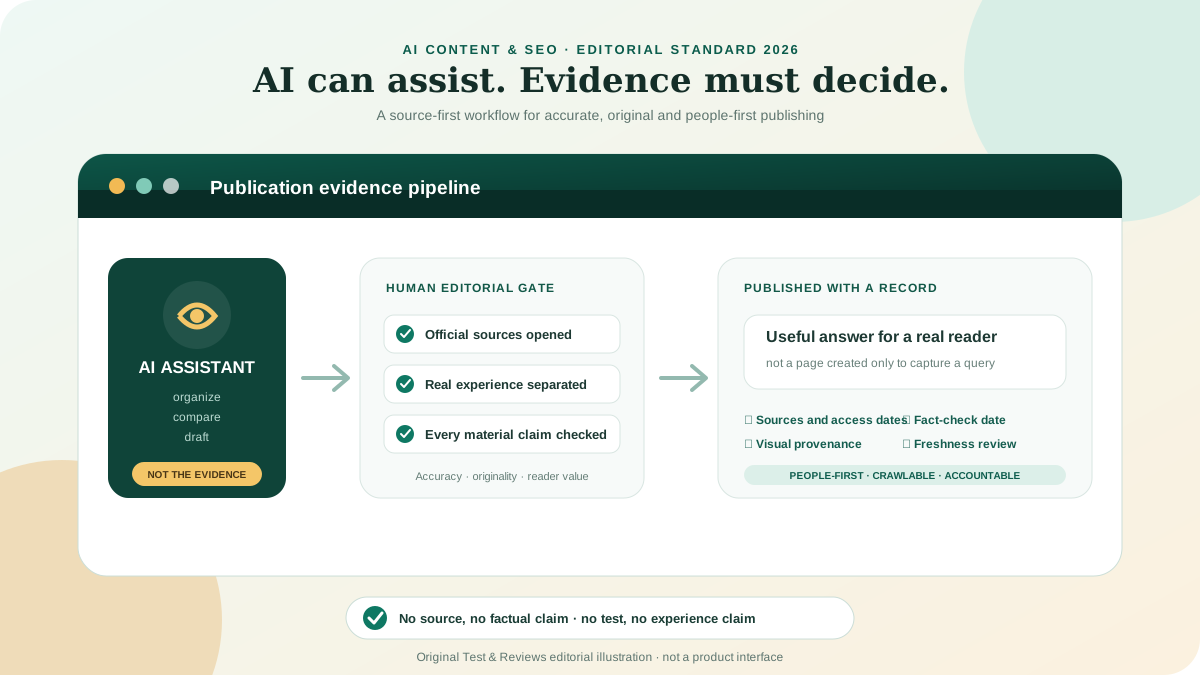
| Our standard | Source every mutable claim, separate experience from research and retain an editorial record. |
What Google actually says about AI content
Google's published guidance focuses on why and how content was created, not on a blanket AI label. Its systems aim to reward original, high-quality, people-first information however it was produced. Automation becomes a spam issue when its primary purpose is manipulating Search rather than helping users.
Google's current guidance for using generative AI says the technology can be useful for researching a topic and adding structure to original content. It also warns that generating many pages without adding value may violate the scaled content abuse policy. Accuracy, quality and relevance apply to the visible article and to titles, descriptions, structured data and image alt text.
There is therefore no safe word count, human-percentage formula or prompt that makes a page compliant. A heavily edited AI draft can still be shallow. A largely automated weather table can be genuinely useful. Evaluate the published result and the purpose of the production system.
The March 2024 update did not ban AI writing
Our original March 2024 article saw sites lose visibility during Google's update and concluded that AI-written content would never be safe and could ruin an entire site. That conclusion went beyond the evidence.
Google described the March 2024 changes as improvements against unhelpful, unoriginal and search-first content. Its revised scaled content policy deliberately covered low-value production whether it was created by automation, people or a mixture. The update did not establish that every affected site was penalized for using AI, nor that ordinary AI assistance was prohibited.
The useful part of the old warning remains: publishing generic articles at scale is a poor long-term strategy. The correction is that the problem is not an AI fingerprint. It is a production model that prioritizes volume and rankings over original value, evidence and reader satisfaction.
What scaled content abuse looks like
Google defines scaled content abuse as creating many pages primarily to manipulate rankings rather than help users. Examples include mass-generating unoriginal pages, scraping or transforming other sources without value, stitching material from different sites, and creating keyword pages that make little sense to a reader.
| Lower-risk assistance | High-risk publishing pattern |
|---|---|
| Summarize source notes for an editor to verify | Publish summaries of other ranking pages as original analysis |
| Suggest an outline for one useful page | Create a separate thin page for every query variation |
| Compare verified product specifications | Invent tests, scores or experience to make a review sound credible |
| Rewrite a difficult paragraph for clarity | Spin or translate existing pages at scale with little added value |
| Find claims that need sources | Publish citations the model generated without opening them |
| Create an original conceptual illustration | Present a generated interface as a real product screenshot |
Volume alone is not proof of spam, and using AI once is not proof of quality. Purpose, originality, supervision and the value of each page are the deciding editorial questions.
Why AI drafts still need fact checking
Generative models produce plausible language, not a guaranteed factual record. NIST calls confidently presented false or internally inconsistent output "confabulation." This is especially dangerous when a model supplies a precise price, feature limit, study, quotation or citation: precision can make an unsupported statement look more trustworthy.
Mutable facts require direct verification on the day of publication. For a software review, that includes:
- current monthly and annual prices, taxes and renewal terms;
- plan limits, credits, users, sites and add-ons;
- refund, cancellation, export and data-retention rules;
- supported platforms, integrations and hardware requirements;
- security or compliance claims;
- ownership changes, renamed plans and discontinued features.
Open the actual official page. Record its URL and access date. If the product hides a term behind login or checkout, say that it is unconfirmed instead of filling the gap from another review or an AI answer.
AI cannot create firsthand experience
A model can describe how a dashboard usually works, but it cannot turn that description into our experience. A review must distinguish four evidence levels:
- Retained test evidence: account, configuration, dated screenshots, measurements and logs we can inspect.
- Owner observation: a clearly dated personal experience without a complete benchmark.
- Official product fact: a current claim supported by the vendor's documentation.
- Independent context: other reviewers or users helping us identify questions, never substituted for our own result.
AI must not convert level three or four into level one. Phrases such as "in our test," "we found" and "our score" require real retained evidence. The FTC also prohibits fake or false consumer reviews and testimonials, including reviews attributed to people who do not exist or who did not have the claimed experience.
Our Ubersuggest review shows this distinction in practice: dated screenshots support the original hands-on observations, while newer AI features, prices and policies are labeled as a separate current fact check.
A safe AI-assisted publishing workflow
1. Start with a reader decision
Define who the page helps and what decision they need to make. A useful brief might be "help a small agency choose between annual SEO plans," not "write 2,500 words targeting ten keywords." Search intent guides coverage; it should not replace the reader's goal.
2. Build a source packet before drafting
Collect official product, pricing, terms, privacy and support pages first. Add primary standards or regulator guidance where relevant. Independent reviews can reveal recurring problems to investigate, but their wording, screenshots, scores and conclusions should not be copied.
3. Preserve the owner's real input separately
Record the keywords the owner wants considered, what was actually used, dates, configuration, opinion, strengths, weaknesses and any evidence files. Keeping this separate prevents an AI draft from silently expanding a short observation into a complete test.
4. Use AI for bounded tasks
Useful tasks include organizing source notes, proposing questions, comparing plan tables, identifying contradictions, drafting an outline and improving clarity. Give the model the source material and require uncertainty to remain visible. Do not ask it to fill missing evidence with likely answers.
5. Verify every material claim
Compare the draft sentence by sentence with the source packet. Recheck prices on the live product page. Open every citation. Remove claims that are not necessary or cannot be supported. For high-stakes health, financial or legal topics, use qualified human review and appropriate primary authorities.
6. Add information only this publication can provide
Original value may be a retained test, a cost model, a decision tree, a comparison using the same workload, an explanation of conflicting terms, or the owner's genuine experience. Rewording the same vendor feature list is not enough.
7. Edit for voice and usefulness
Remove generic introductions, repeated conclusions, exaggerated metaphors, filler questions and mechanical transitions. Make headings answer real questions. Shorten passages that restate the same point. Natural language matters because a reader should not need to decode a template.
8. Run the publication checks
Validate links, dates, canonical URL, headings, accessibility, image alt text, structured data and mobile layout. Confirm that any score has visible supporting evidence and that affiliate relationships are disclosed close to the recommendation.
9. Retain the record and schedule the update
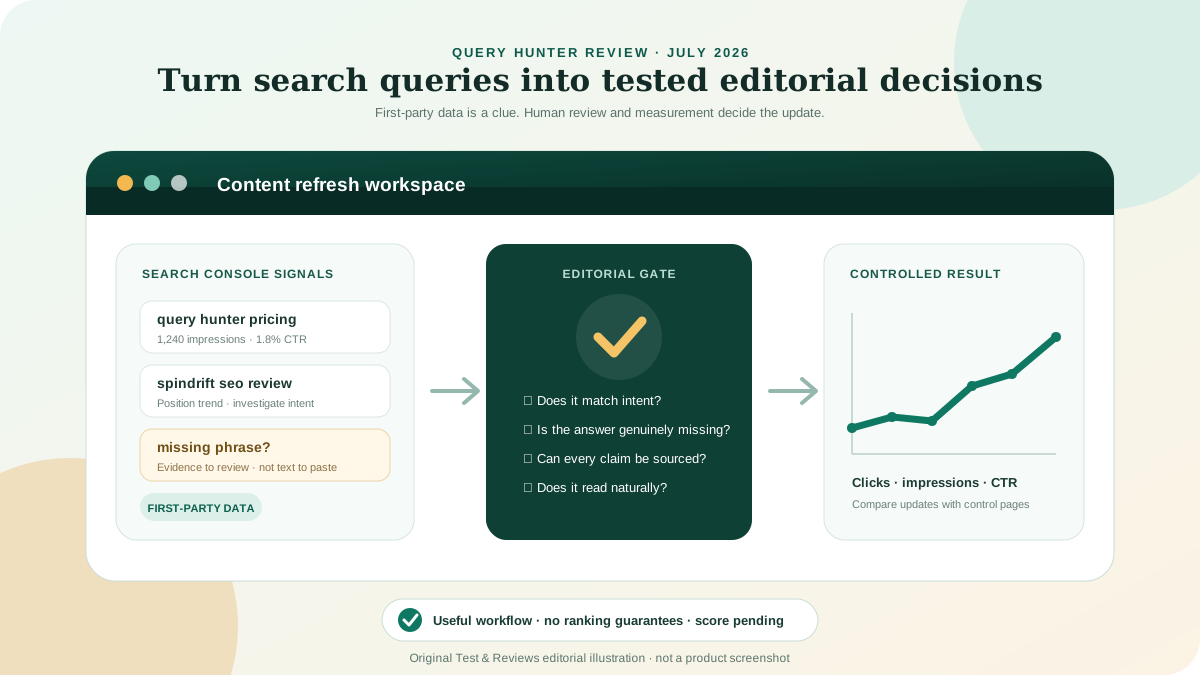
Save the research packet, original evidence, generated visual provenance, fact-check date and next review date. After publication, monitor Search Console and reader behavior, but do not rewrite a page after every ranking fluctuation. Update when facts change, a reader need is unmet or a controlled test supports a better answer.
Should AI-generated content be disclosed?
Google recommends giving readers useful context about how content was created when automation played a meaningful role. It does not publish a universal rule requiring an "AI-generated" badge for every spellcheck, outline or assisted paragraph.
The useful disclosure is specific. Name the author or editorial team, explain the research and review process, show what was tested, distinguish sourced facts from experience and disclose material commercial relationships. If automation created a large data set, translation, image or substantial first draft, explain that in a place readers can find.
Disclosure does not repair weak content. "Written by AI" does not make invented facts acceptable, just as a human byline does not make copied or misleading material helpful.
AI images, screenshots and product evidence
A real screenshot can document the interface, settings or test result that existed on a particular date. Keep the source, date and relevant context, and use only what is necessary for commentary. Official media assets can also be useful when their license permits the intended use.
An AI-generated image is suitable for a conceptual hero, diagram or original illustration. It must not be presented as a genuine product screen, performance result or customer. Redrawing a vendor interface so closely that readers believe it is real undermines the evidence even if the pixels are new.
Our visual record should state whether an asset is a real screenshot, an official press asset, a licensed stock image or an original AI/code-generated illustration. Conceptual images should say that they are not product screenshots. Alt text must describe the image accurately rather than add keywords.
Do you need special AEO or GEO tricks?
Google's 2026 guidance says ordinary SEO foundations still apply to AI Overviews and AI Mode. It recommends valuable, non-commodity content, a clear technical structure, crawlable pages, accurate structured data, useful images and a good page experience.
Google also warns against creating separate pages for every fan-out query and says no special AI text file, markup or perfect content chunking is required for visibility in its generative features. Do not let a new acronym sell you the same old shortcut. Make the best source for the reader, keep it technically accessible and measure real visibility in Search Console where the relevant reports are available.
Our policy at Test & Reviews
- AI may assist research organization, comparison, drafting and editing.
- Current prices and material product claims are checked on the actual official source.
- Other reviews provide context and test questions, not copy or borrowed conclusions.
- Personal experience is supplied by the owner and never generated.
- A numeric score requires retained evidence under the published scoring framework.
- Generated illustrations carry provenance and are not presented as screenshots.
- The full article is reviewed for accuracy, usefulness, links, accessibility and disclosure before production.
- Every completed article receives a fact-check date and a scheduled freshness review.
Final verdict
Use AI as an editorial assistant, not as the author of facts or experience. AI can make a careful publisher faster, but it can make a volume-first publisher dangerously efficient. Google is not asking whether a model touched the draft; its policies and quality guidance ask whether the resulting page helps people and adds trustworthy value.
The safest practical rule is simple: no source, no factual claim; no retained test, no claimed experience; no original value, no reason to publish. That standard produces fewer pages, but each page has a much better reason to exist.
Frequently asked questions
Can AI-generated content rank on Google?
Yes. Google says it focuses on content quality rather than banning content based solely on how it was produced. AI-assisted pages still need to be original, accurate, useful and compliant with Search policies.
Does Google penalize all AI content?
No. Automation, including generative AI, violates spam policy when its primary purpose is manipulating rankings. Scaled low-value content can be abusive whether it is produced by AI, humans or a combination.
How much human editing is enough?
There is no official percentage. Human editing is meaningful only when it verifies facts, improves the answer, adds genuine expertise or experience and takes responsibility for the finished page.
Should every AI-assisted article have a disclosure?
Google recommends useful creation context when automation had a meaningful role, but does not require a universal badge for every minor use. Disclose the method at the level readers need to evaluate trust, and always disclose material commercial relationships.
Can AI write product reviews?
AI can help structure and edit a review, but it cannot supply personal experience. A review must not claim testing, ownership, support interactions or results that did not happen and were not retained.
Can AI-generated images replace screenshots?
They can replace generic decorative artwork, not evidence. Label generated illustrations clearly and never present a fabricated interface, benchmark or person as authentic.
Will an llms.txt file improve Google AI visibility?
Google's current guidance says no special AI text file or markup is required for its Search generative features. Focus on crawlability, helpful content, accurate structured data and established SEO fundamentals.
Sources and update record
This guide was checked against Google's official guidance on using generative AI content, people-first content, scaled content abuse, the March 2024 update, generative AI Search optimization and the reviews system. Factual-risk context comes from the NIST Generative AI Profile. Review and endorsement safeguards were checked against the FTC's review and endorsement guidance. Facts were last reviewed July 22, 2026.