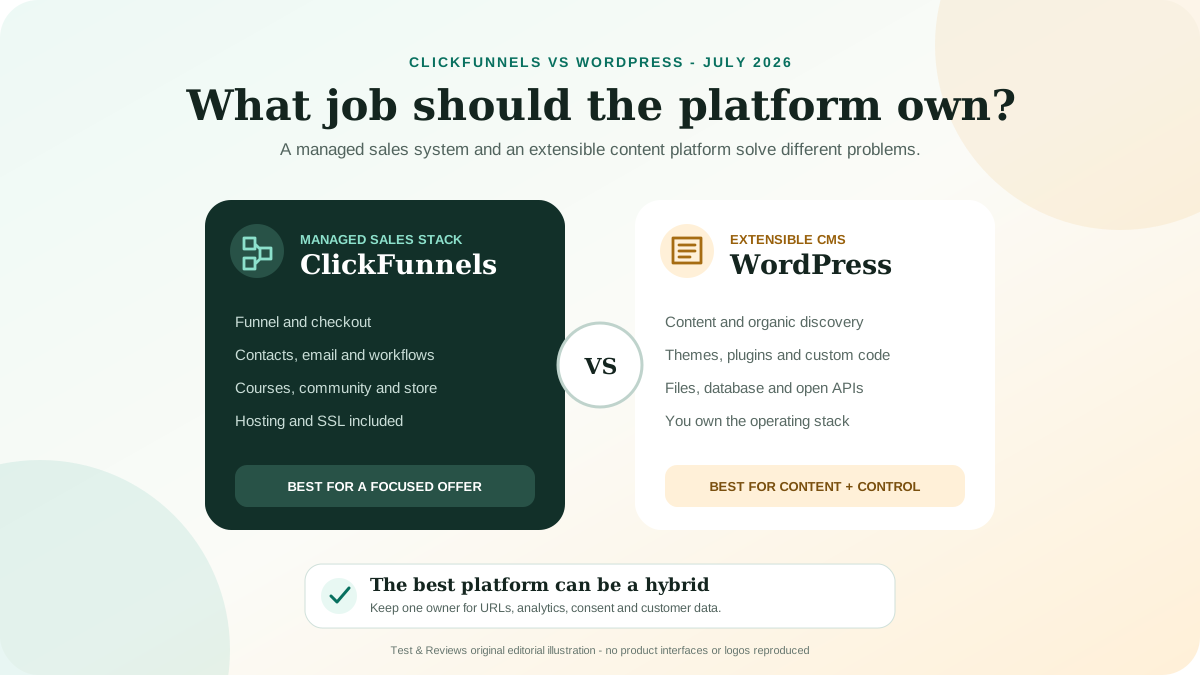
Choose ClickFunnels when one focused offer, its funnel, checkout, follow-up emails and course or community should live in one managed sales platform. Choose self-hosted WordPress when content, organic discovery, design freedom and long-term control over the site matter more than having a funnel stack assembled for you.
This comparison means WordPress.org software installed on hosting, not the separate WordPress.com hosted service. ClickFunnels and WordPress overlap, but they are not equivalent subscriptions. ClickFunnels bundles several business functions; WordPress core is free and open source, while hosting, maintenance and any commercial funnel, email, CRM or ecommerce components are separate decisions.
ClickFunnels vs WordPress: the short verdict
| Decision | ClickFunnels | Self-hosted WordPress |
|---|---|---|
| Best fit | Sales funnels, lead magnets, launches, courses and offer automation | Editorial sites, service sites, stores and custom web platforms |
| Operating model | Managed software service with hosting and SSL included | Open-source software installed on hosting you choose |
| Starting platform price | Launch: $97 monthly or $970 annually | Core software: $0; hosting, domain, extensions and labor vary |
| Built-in sales stack | Funnels, contacts, email, workflows, checkout, courses, community and store | Assembled with plugins, services or custom development |
| Content and publishing | Site and blog tools with basic SEO controls | Mature CMS with extensible content types, taxonomies and APIs |
| Maintenance | Vendor maintains the hosted platform; customer owns configuration and integrations | Owner or managed host maintains core, themes, plugins, backups and runtime |
| Portability | Contacts, orders and product data have documented CSV exports; test the rest | Content has a documented XML export; database, files and code can also be retained |
| Primary tradeoff | Higher fixed subscription and greater platform dependency | More ownership and flexibility, with more integration and maintenance responsibility |
Our default rule: do not buy ClickFunnels to run an ordinary company website or blog, and do not build a large WordPress plugin stack merely to avoid one subscription. Choose the operating model that matches the revenue workflow.
Who should choose ClickFunnels?
ClickFunnels is a sensible starting point when the funnel is the business system, not a small part of a broad website. A coach, course seller, lead-generation business or product launch may need landing pages, opt-ins, order forms, upsells, email sequences, contacts and fulfillment to work together immediately.
The current Launch plan includes one workspace, two team members, up to 10,000 email contacts, 50,000 emails per month, three courses, three communities, five custom domains and one store. The pricing page currently advertises unlimited funnels and visitors, but labels unlimited funnels as a limited-time offer. Treat the checkout and account terms as authoritative before buying.
ClickFunnels fits best when:
- One team owns the offer from ad or opt-in through purchase and follow-up.
- Built-in email, contact records and workflows can replace separate subscriptions.
- A course, membership or community is directly attached to the offer.
- Fast iteration is worth more than deep control of the underlying platform.
- The business can measure subscription cost against leads, conversion and order value.
Do not choose it merely because drag-and-drop sounds easier. Independent 2026 review patterns include both praise for quickly building funnels and reports that the wider platform can initially feel cluttered. An all-in-one product removes integrations only when the team actually uses the included functions.
Who should choose WordPress?
WordPress is the stronger foundation when the website is primarily a body of content or a flexible digital property. It supports posts, pages, users, media, custom content types, taxonomies and a REST API. The GPL license allows the software to be used and modified without a WordPress licensing fee.
WordPress fits best when:
- Articles, guides, documentation or organic search create long-term value.
- The business needs custom content relationships or unusual functionality.
- Developers must control code, hosting, redirects, structured data and deployment.
- The site should not depend on one funnel vendor's editor and account structure.
- The owner accepts maintenance or pays a managed host or specialist to own it.
The flexibility is real, but it is not free operationally. Every theme, plugin, service and custom integration adds an owner, update path and failure mode. A small WordPress site with five deliberate components can be easier to run than one with 35 overlapping plugins.
Pricing: bundle versus build
Current ClickFunnels plans
Public US prices were checked on July 22, 2026:
| Plan | Monthly | Annual total | Selected capacity |
|---|---|---|---|
| Launch | $97 | $970 | 1 workspace, 2 team members, 10K contacts, 50K emails/month, 3 courses, 5 domains, 1 store |
| Scale | $197 | $1,970 | 5 workspaces, 5 team members, 75K contacts, 300K emails/month, 6 courses, unlimited domains, 5 stores |
| Optimize | $297 | $2,970 | 10 workspaces, 10 team members, 150K contacts, 750K emails/month, 10 courses, 10 stores |
| Dominate | Annual only | $5,997 | 20 workspaces, 20 team members, 400K contacts, 1.2M emails/month, 20 courses, 20 stores |
The subscription does not remove every external cost. A domain and payment processor are still separate. ClickFunnels says it adds no transaction fee beyond the chosen processor, but Stripe, Payments AI, invoicing, tax, recurring billing and local payment methods can have their own fees.
The honest WordPress cost formula
WordPress core costs $0, but “WordPress is free” is not a useful purchasing comparison. Budget the complete working system:
Annual WordPress cost = hosting + domain + premium theme or builder + funnel and form tools + email or CRM + ecommerce or course extensions + backup and security services + maintenance labor.
A content site can use free themes and plugins and pay mainly for hosting and a domain. A ClickFunnels-equivalent WordPress stack may require a page or funnel builder, forms, email delivery, automation, CRM, checkout, subscriptions, courses, analytics and testing. Those subscriptions and integration hours can exceed ClickFunnels even when WordPress itself remains free.
Conversely, a business that already has email, CRM and checkout should not pay ClickFunnels for duplicated capacity without a clear gain. Use our current hosting guide to understand hosting plans and renewal terms rather than using one promotional headline as the WordPress cost.
Funnel building and conversion work
ClickFunnels starts with a connected sequence. Funnel steps can contain pages, split tests, conditional paths and actions. Workflows can react to opt-ins, purchases, page visits or abandoned carts, then send email, tag contacts, enroll customers or trigger webhooks. This coherence is its strongest advantage.
WordPress can reproduce most individual functions, but “can” is not the same as “already works together.” A builder, form, CRM, email service, checkout and testing plugin may each use a different data model and support team. The stack owner must test every critical handoff and update.
WordPress wins when the funnel requires unusual behavior, custom code or a component the organization already operates well. ClickFunnels wins when its standard workflow fits and eliminates meaningful setup and maintenance.
Content, SEO and publishing
WordPress remains the more capable content foundation. Its post types, taxonomies, themes, plugins and APIs support large archives and custom editorial structures. It also gives technical teams deeper control over templates, structured data, caching, redirects and hosting.
ClickFunnels is not invisible to search engines. Its current Site and Blog tools support titles, descriptions, paths, categories, authors and scheduled posts. Connected domains receive an automatically generated sitemap, and page settings control whether a URL is included. Store, course, funnel and landing-page URLs can also enter the sitemap when configured for indexing.
Neither platform earns rankings by itself. Search performance depends on useful content, crawlable architecture, internal links, page quality, speed, structured data, reputation and keeping index settings correct. WordPress offers more control; ClickFunnels offers enough basic controls for a focused site, but a content-heavy publication should test archive navigation, canonical behavior, redirects and exports before committing.
Ecommerce, courses and customer data
ClickFunnels connects products, checkouts, orders, subscriptions, courses, communities and customer activity inside its workspace. That is attractive when the same offer drives the entire relationship. Its documented exports cover contacts, orders and product details in CSV form.
WordPress commonly adds WooCommerce for a store. WooCommerce core is free and open source, but hosting requirements, payment processing and commercial extensions still apply. WordPress also has many course and membership options, which creates choice as well as integration work.
Before choosing either platform, run an exit test. Export ten contacts, orders, products and one piece of course or membership data. Confirm fields, consent records, subscription identifiers, tax data, refunds and media. A CSV of customers is valuable, but it is not the same as a portable page design, workflow or course experience.
Security and maintenance responsibility
ClickFunnels
ClickFunnels manages the hosted application, infrastructure and SSL for connected domains. The customer still controls account access, roles, domains, custom code, tracking scripts, integrations, consent, payment-provider settings and the data entered into the platform. Managed hosting does not remove business security responsibility.
WordPress
The WordPress Security Team maintains core, but a self-hosted site also depends on its host, PHP and database versions, themes, plugins and administrator practices. WordPress documentation recommends current software, backups and ongoing updates. Plugin and theme auto-updates can be enabled individually, but updates still need monitoring and a tested rollback path.
The fair comparison is therefore not “ClickFunnels secure, WordPress insecure.” It is one vendor-managed application versus an ecosystem the owner or managed provider assembles and operates.
Ownership and migration
WordPress explicitly emphasizes ownership of content and data. Its built-in export creates a WXR XML file containing posts, pages, comments, custom fields, categories, tags, custom taxonomies and users. A complete migration should also preserve the database, media, themes, plugins, configuration and redirect map.
This publication provides a relevant case study. Test & Reviews began as WordPress content, and the owner originally described Kadence as the easiest professional theme system he had tried at the time. In 2026, we preserved the WordPress XML, article media and URLs while rebuilding production as a static Cloudflare Pages site. The content was portable, but turning it into a different production system required structured migration, new templates, audits and redirects.
We have no equivalent retained ClickFunnels migration or current hands-on test. ClickFunnels documents exports for important commercial records, but buyers should verify every asset and relationship they would need to recreate elsewhere. Until a full export test proves otherwise, budget for manual reconstruction of platform-specific pages and automations.
When a hybrid setup is better
A common answer is WordPress for the main content site and ClickFunnels on a dedicated subdomain for campaigns, checkout or course fulfillment. This can preserve a content-first site while giving the sales team a managed funnel workflow.
A hybrid is justified only when the boundaries are documented:
- Which domain and platform own each page and canonical URL.
- How analytics, attribution and consent work across domains.
- Which system is the source of truth for contacts and subscription status.
- How branding, navigation, legal pages and accessibility stay consistent.
- What happens when a funnel URL changes or the subscription ends.
If the hybrid duplicates forms, contacts and email automations, it may be the most complex option rather than the best of both.
A practical decision tree
- Is most acquisition paid traffic to one or a few offers? Start a ClickFunnels trial.
- Is most value in articles, documentation or organic discovery? Start with WordPress or another content-first architecture.
- Do existing CRM, email and checkout systems already work? Prefer WordPress or a focused landing-page tool unless ClickFunnels replaces real cost.
- Does the team lack a technical owner? Price ClickFunnels against fully managed WordPress, not cheap unmanaged hosting.
- Are custom content and portability essential? Prefer WordPress and keep the plugin stack small.
- Are both content and complex funnels important? Test a documented hybrid with one customer system of record.
How we will test ClickFunnels against WordPress
A future numerical verdict requires two functionally equivalent builds, not a template beauty contest. The shared test will create one lead-magnet funnel with an opt-in, three-email sequence, paid product, order bump, thank-you page and a five-lesson course.
- Build the same pages and responsive states from one brief.
- Connect the same domain strategy, analytics and consent requirements.
- Complete test purchases, refunds and failed-payment recovery.
- Measure setup time, external services, subscription cost and maintenance.
- Run accessibility, performance, metadata, canonical, sitemap and structured-data checks.
- Change the offer price and one email after launch and measure revision time.
- Export contacts, orders, content and media, then estimate reconstruction effort.
- Repeat the key workflow after platform and plugin updates.
Until that benchmark is retained, we make a use-case recommendation and publish no winner score.
Final verdict
ClickFunnels is the better sales appliance. Its $970 annual Launch plan can be rational when it replaces a funnel builder, email system, simple CRM, course platform and automation glue for a focused offer. The value disappears when those included tools go unused or duplicate systems the company already has.
WordPress is the better general web foundation. It is the more flexible choice for content, organic search, custom functionality and control, but someone must own hosting, updates, backups, integrations and recovery. Its $0 license is not its total operating cost.
For a content-heavy review publication like Test & Reviews, ClickFunnels would be the wrong primary platform. WordPress was closer to the publishing need, while the current static architecture removes runtime CMS maintenance entirely. Platform selection should begin with the operating job, not a universal winner.
Frequently asked questions
Is ClickFunnels cheaper than WordPress?
Not as a bare website. ClickFunnels Launch is $97 monthly or $970 annually, while WordPress core is free. ClickFunnels can be cheaper than a complete WordPress sales stack when it replaces several paid tools and integration work.
Can ClickFunnels run a blog and support SEO?
Yes. It has Site and Blog tools, editable titles, descriptions and paths, plus automatic sitemaps for connected domains. WordPress remains more flexible for large content archives and technical customization.
Can WordPress build sales funnels?
Yes, using a theme, blocks, plugins, external services or custom code. The important question is whether the resulting checkout, email, CRM, analytics and course handoffs are reliable and maintainable.
Does ClickFunnels include hosting and SSL?
Yes, ClickFunnels says hosting and SSL are included for connected domains. A domain and payment processing remain separate.
Can ClickFunnels and WordPress be used together?
Yes. A content site can remain on WordPress while campaigns use ClickFunnels on a subdomain. Define canonical URLs, analytics, consent, branding, redirects and the customer source of truth first.
Which is better for ownership and migration?
Self-hosted WordPress offers deeper access to code, database, files and a documented content export. ClickFunnels documents CSV exports for contacts, orders and products, but platform-specific pages and workflows should be tested for exit effort.
Sources and change log
Current facts were checked against the official ClickFunnels pricing page, 2026 ClickFunnels pricing documentation, workflow documentation, sitemap documentation, payment documentation, WordPress features and ownership, WordPress export documentation and WordPress security guidance. Current Capterra and G2 review patterns were used to define usability and value questions; their scores and experiences are not represented as ours.
July 22, 2026: rebuilt the comparison around business model and operating responsibility; replaced obsolete ClickFunnels pricing; separated WordPress.org from WordPress.com; added current funnel, blog, sitemap, email, export and payment evidence; preserved the owner's dated WordPress/Kadence context; removed unsupported universal claims and ratings.